FloodSax deployed after drains overwhelmed at 40,000sq ft warehouse
An unnamed north east England warehouse used absorbent sandless bags to protect offices during heavy rain, according to a Flood Industry account.
Key facts
- Flood Industry reports that FloodSax were deployed during flooding at a 40,000sq ft warehouse in north east England.
- The warehouse supervisor reported water reaching an inch deep in some areas.
- Warehouse stock stood on pallets at least four inches above the floor.
- The source reports no stock damage following the warehouse incident.
- FloodSax contain an absorbent gelling polymer that expands as it takes up water.
- The source gives an approximate retail price of £140 for a box of around 20 FloodSax.
Heavy rain overwhelms warehouse drainage
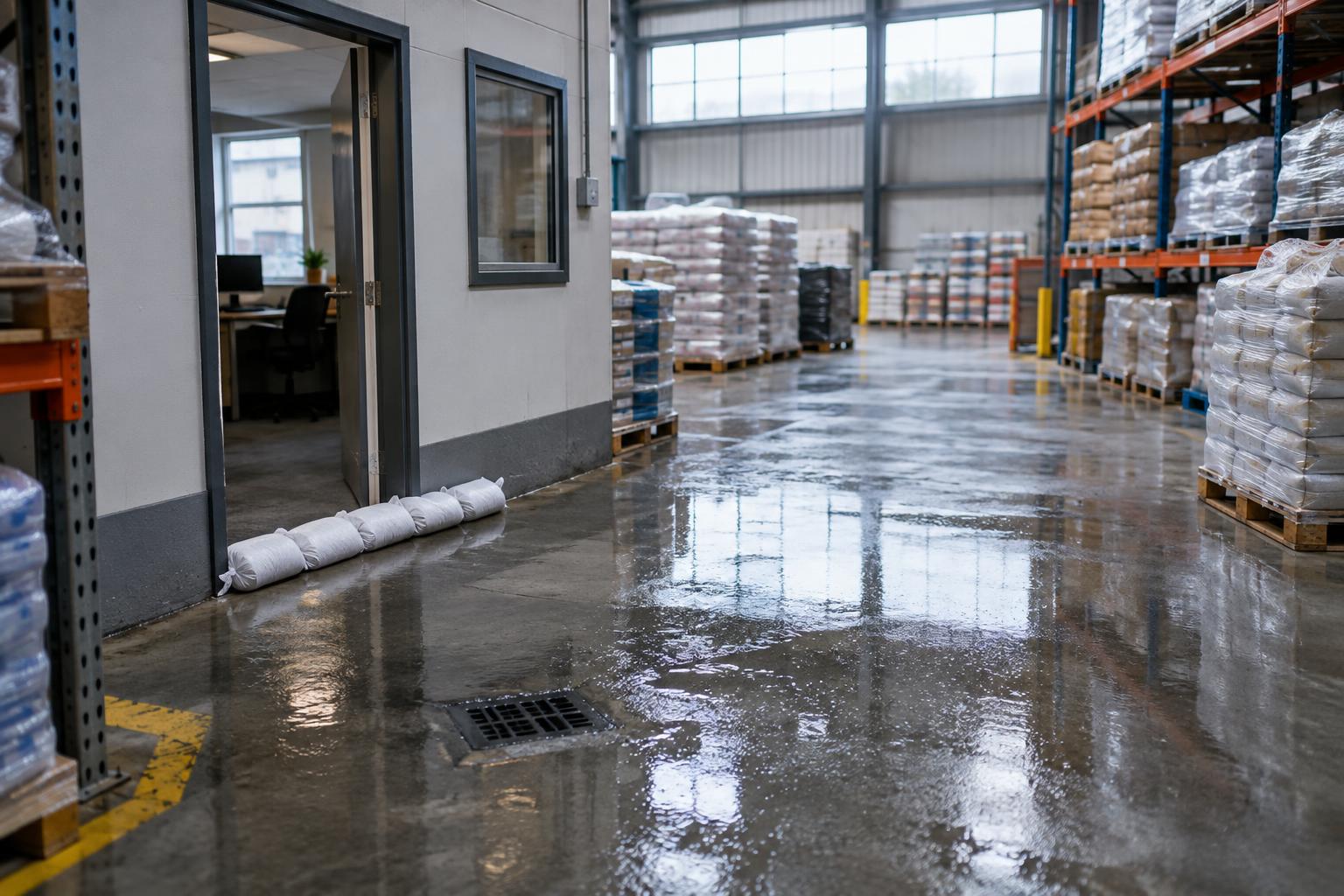
A warehouse supervisor deployed absorbent FloodSax bags to protect offices and restrict water entering from ground-level drains after heavy rain flooded a 40,000sq ft building in north east England, according to an account published by Flood Industry. The unnamed warehouse already held a supply of the sandless bags for emergency use.
The incident began on a Saturday afternoon during summer, while the building was unoccupied. Concerned about the intensity of the rainfall, the supervisor checked the warehouse’s CCTV remotely from home and saw water entering the premises, prompting him to respond.
The supervisor attributed the flooding to rainfall that exceeded the capacity of the downpipes and drains. In his account, water backed up the drainpipes and found a route into the building, where it began spreading across the warehouse floor.
Floodwater reached an inch deep in some areas, according to the report. The immediate concern was that it would spread into the offices and damage the company’s electrical equipment, with the account identifying potential damage running into thousands of pounds.
The supervisor placed bags to keep water out of the offices and used others to stop water flowing from drains at ground level into the warehouse. He also described their role in absorbing water across the large floor area, rather than attempting to clear it by brushing it away.
Flood Industry reported no damage to stock following the incident. The supervisor said the warehouse had prepared for flooding by keeping all stock on pallets at least four inches above floor level; that storage arrangement was in place before the bags were deployed.
Absorbent bags serve internal and external uses
FloodSax contain an absorbent gelling polymer, a material that takes up and retains water as it expands. Flood Industry describes two distinct methods of deployment: placing dry bags inside a building to absorb leaks or floodwater, and immersing them in water before arranging them as an external barrier.
In their dry condition, the bags are thin and have a large surface area, according to the source. This form allows them to be positioned in confined locations to collect water, including beneath floorboards, where access to a leak or accumulated water may be difficult.
The account also identifies spaces beneath sinks, pipes, radiators and boilers as locations for internal use. It describes the bags as suitable for absorbing drips and leaks as well as internal flooding, extending the stated applications beyond the rainfall-driven incident at the warehouse.
For external deployment, the source instructs users to immerse the bags fully in water. The polymer absorbs and holds that water, increasing the bags’ volume so that they can serve as sandless alternatives to conventional sandbags; this preparation differs from deploying them dry to absorb water indoors.
Several expanded bags can then be arranged outside a property to form a barrier, according to Flood Industry. The source describes using that arrangement either to restrict water entering the building or to divert it towards drains, rather than solely collecting water after it has reached an internal floor.
The account gives a normal retail price of around £140 for a box of around 20 FloodSax, the box size it associates with the warehouse response. It provides no date for that price, which is a reported approximate retail figure rather than a confirmed procurement cost for the warehouse.
Users describe leak response and floor protection
A West Yorkshire homeowner used FloodSax to collect water from a kitchen cupboard and a wood-effect floor after a boiling water dispenser failed, according to Flood Industry. The account identifies the owner only as Richard and says the appliance, installed beneath the sink, short-circuited and burned out. Water then leaked from the tap into the cupboard before spreading onto the floor.
Richard already had a pack available and deployed the bags immediately in both affected areas. He said they collected the water quickly and prevented it spreading further. His account describes a response to an appliance-related escape of water, rather than water entering the house from outside.
Richard believed the intervention might have avoided the need to replace parts of the floor. That remains the homeowner’s assessment: the source gives no repair cost, subsequent floor inspection findings or independently verified saving. It also describes the surface only as wood-effect, without identifying its material or construction.
Flood Industry also reports use by an unnamed large supermarket chain, mainly for drips through leaking roofs and water beneath large refrigerators. The stated purpose is to reduce the risk of customers and staff slipping and falling. The source does not identify the stores involved or provide figures showing any change in slip incidents.
Reported preparedness for further flooding
A church in Durban, South Africa, has retained supplies of FloodSax following a flood that affected its 100-year-old wooden floor, according to the same account. Worshippers initially feared the flooding had left the floor beyond repair. The source does not name the church or give the date of the incident.
Flood Industry attributes the floor’s preservation to the bags absorbing the floodwater. It provides no details of the flood depth, the number of bags deployed or any subsequent drying and restoration work. The reported outcome therefore concerns one installation, rather than a quantified assessment of performance across different timber floors.
The account describes the church’s current supply as sufficient for future flooding emergencies, but gives neither a stock quantity nor the basis for that assessment. Its preparedness claim relates to this South African site; the source announces no UK church procurement programme or wider rollout.
Why this matters
For drainage and flood risk professionals, the user accounts identify floor protection and slip prevention as objectives alongside managing water entry. The evidence is qualitative: reported successes do not establish absorption capacity, required stock levels or avoided repair costs. That distinction matters when assessing a product for an emergency response plan, particularly where a claim of preparedness is not accompanied by a stated flood volume or deployment quantity.
Frequently asked questions
what are FloodSax?
FloodSax are sandless bags containing an absorbent gelling polymer. According to the source, they can absorb water inside buildings or be immersed in water to expand before use as an external barrier.
how do FloodSax work?
The polymer inside absorbs and retains water. The bags are thin when dry; full immersion makes them expand into sandless bags that can be arranged into a barrier.
can FloodSax be used indoors?
The source describes their use for leaks and internal flooding beneath floorboards, sinks, pipes, radiators and boilers. It also reports deployment in a warehouse and a West Yorkshire home.
how much do FloodSax cost?
The source says a box of around 20 FloodSax normally retails for around £140. It provides no date for that price.
can FloodSax be used outside?
According to the source, several water-expanded bags can form a barrier outside a property to restrict water entry or divert water towards drains.
how were FloodSax used in a warehouse flood?
A supervisor used them to keep water out of offices and stop water entering from ground-level drains. The source reports no stock damage; stock was stored on pallets at least four inches above the floor.
can FloodSax absorb water from a leaking appliance?
The source describes a West Yorkshire homeowner using FloodSax in a cupboard and on the floor after an under-sink boiling water dispenser failed and water leaked from the tap.