Foul water drainage: consultancy urges CCTV checks at homes over 50 years old
The Drainage Designers recommends condition surveys at older homes, warning that clearing blockages alone leaves cracked pipes and root entry points unresolved.
Key facts
- The Drainage Designers recommends professional drainage surveys for homes more than 50 years old.
- CCTV drain surveys can identify cracks, displaced pipe sections, blockages, root intrusion and corrosion.
- The consultancy gives typical clay and terracotta pipe lifespans of 50 to 80 years.
- The guidance warns that roots can regrow after clearing unless their entry points are sealed.
- The consultancy advises owners to request survey footage, condition grades and written repair recommendations.
Consultancy recommends condition checks for older domestic drains
The Drainage Designers (Woodvale consulting Ltd) recommends professional drainage surveys for homes more than 50 years old to establish whether buried pipework remains serviceable. Its guidance, marked as updated on 6 October 2026, presents inspection as a way to plan repairs or replacement before failure, rather than as a regulatory requirement.
The consultancy bases its advice on deterioration patterns it says it has encountered when investigating older properties. It identifies homes built before 1970 as likely to have drainage at or beyond its expected service life, while warning that Victorian and Edwardian properties can have infrastructure aged 100 to 150 years that was not designed for modern water usage.
The guidance concerns foul water drainage: pipes carrying wastewater from toilets, sinks, showers and washing machines to treatment works or septic tanks. That wastewater includes human waste and detergents. Surface-water drainage instead takes rainwater from roofs and paved areas, with potential destinations including watercourses, soakaways and public surface-water sewers.
Establishing which arrangement serves a property forms part of diagnosing faults. According to the consultancy, older homes often have combined drainage, with rainwater and wastewater passing through the same pipe, whereas modern systems separate those flows. Missing original plans and undocumented alterations can also leave owners uncertain about pipe routes, condition and connections serving neighbouring properties.
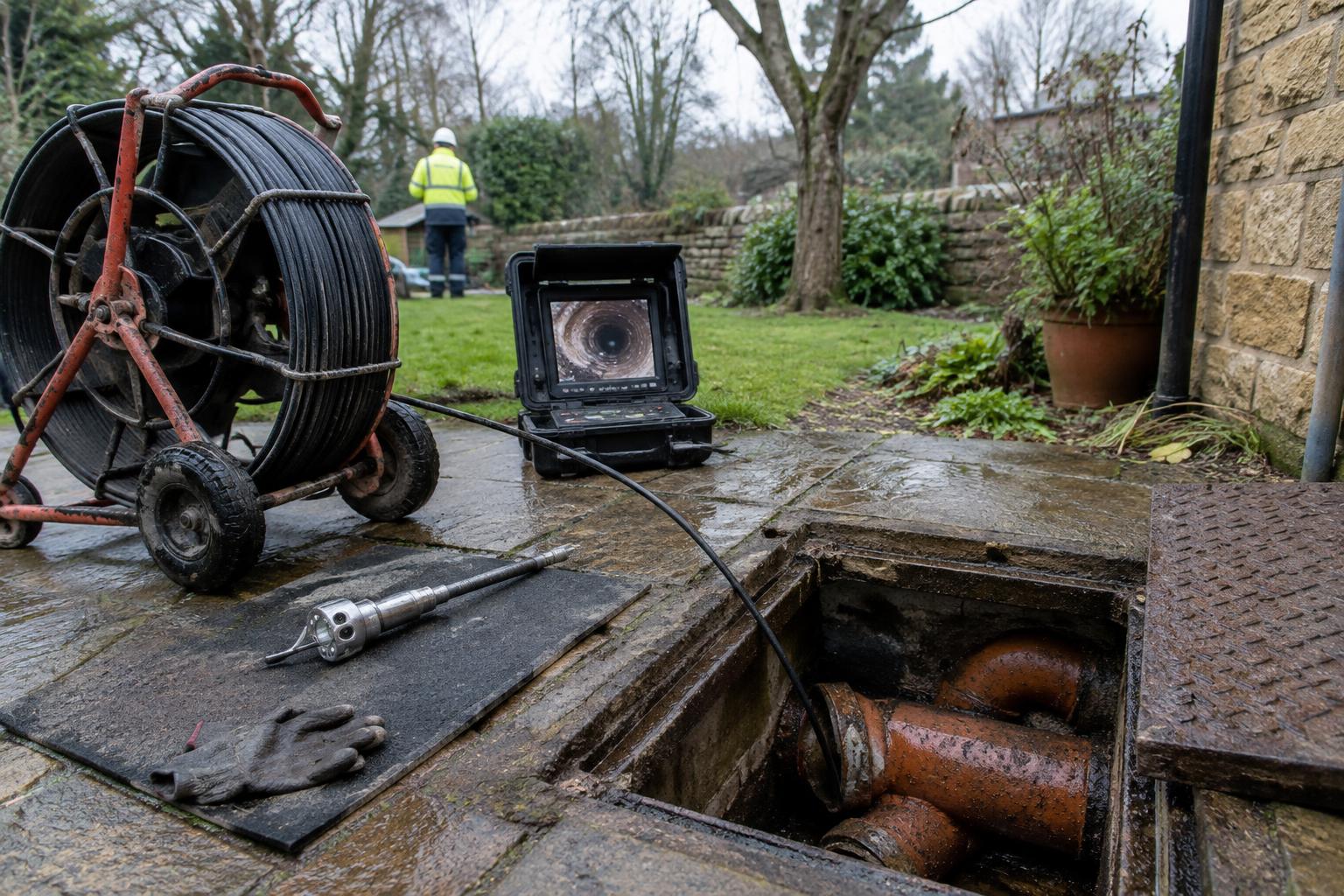
The recommended investigation uses closed-circuit television (CCTV): a small camera mounted on a flexible rod transmits images from inside the drain to a monitor. Surveyors enter through an inspection chamber or the main stack, avoiding excavation for the inspection itself. Recorded footage allows subsequent review of the location and severity of cracks, displaced sections, obstructions, roots and corrosion.
The guidance describes section-by-section condition grades as a means of translating that evidence into action. It says grades 1 and 2 represent minor wear suitable for monitoring, grade 3 identifies defects needing attention before deterioration, and grades 4 and 5 typically call for urgent repair or replacement. Owners should request the footage, grading sheet and written justification for proposed repairs.
For prospective buyers, the consultancy says drainage investigations can expose problems that a standard home survey might miss. Where shared connections complicate responsibility, it advises contacting the local water company for a sewer map identifying public and private drainage. The guidance cites the Water Industry Act 1991 when explaining sewerage companies’ general responsibility for maintaining and repairing public sewers.
Ageing materials and failed joints create interacting defects
The consultancy gives typical service lives of 50 to 80 years for clay and terracotta pipes, and 75 to 100 years for cast iron if it has not corroded. Its account distinguishes several deterioration mechanisms: clay becomes brittle, terracotta cracks under soil pressure, and cast iron corrodes internally, reducing flow capacity while weakening the pipe.
Age alone is not the only pressure on those materials. The guidance says structural integrity can decline after 60 to 80 years underground, with soil movement and pressure from tree roots accelerating damage. It uses a 70-year-old clay pipe to illustrate increased brittleness and says subsidence or heave can move sections by centimetres.
Connections can deteriorate before the adjoining pipes, according to the consultancy. Older clay-to-clay joints relied on lime mortar or simple mechanical connections that can shift with ground movement. Failed joints allow wastewater to escape and groundwater to enter; leakage can erode surrounding soil, undermine neighbouring sections and contribute to subsidence, dampness and damage beneath foundations.
Displacement also changes the gradient, or fall along the pipe, slowing wastewater and allowing solids to settle. Cracks admit soil and create locations where obstructions develop as the damaged section weakens. The guidance links these processes: movement can impair both the pipe’s structural condition and its ability to carry wastewater without accumulating material.
Roots exploit cracks and failed joints in clay, terracotta and concrete pipes because wastewater supplies moisture and nutrients, the consultancy says. It identifies mature trees as a particular concern and names oak, willow and poplar as aggressive species. Root growth can progressively obstruct or collapse a pipe, with slow drainage appearing months before a complete blockage develops.
Mechanical root cutting provides only temporary relief if the entry point stays open, the guidance warns; roots can regrow unless the defect is sealed through relining or replacement. Separate accumulations of grease, hair, debris and mineral deposits can obstruct otherwise sound pipework. The consultancy highlights the limited room for build-up within a 100-millimetre pipe and describes cooling cooking oil coating its interior and trapping further debris.
Leaves and soil entering damaged sections can lodge where the gradient is poor, so cleaning alone cannot correct the underlying crack or deterioration. Warning signs listed in the guidance include slow drainage across several fixtures, sewage smells, damp garden patches and pooling after light rain. It also describes soft ground, grass dying or becoming unusually green, and patches remaining unfrozen in winter; CCTV investigation is its recommended means of locating and identifying the fault.
Guidance warns against treating recurring blockages in isolation
The Drainage Designers distinguishes an isolated slow-draining sink from a fault affecting the main drainage line. Its guidance associates the former with a local problem, while identifying simultaneous difficulties at the bath, shower and toilet as grounds for investigating the main system. That distinction concerns the likely extent of the investigation, rather than providing a definitive diagnosis.
The consultancy also distinguishes between odours outside a property and gases escaping indoors. It says external sewage smells can become particularly noticeable after heavy rain, linking that change to a rising water table and increased pressure. The weather conditions accompanying an odour therefore form part of its account of how leakage may become apparent.
For indoor sewage smells, the guidance identifies three possible causes: a broken trap, a crack in the main line or a blocked vent pipe. Traps and ventilation form part of the arrangements controlling drainage gases. The consultancy describes gases entering the home as a health hazard, rather than simply a nuisance associated with an obstructed drain.
The guidance warns against waiting until sewage backs up into the home before seeking assistance. By that stage, the consultancy says, damage can be extensive and the repair bill substantial. Its advice places that consequence beyond the inconvenience of slow discharge, identifying an internal sewage backup as a potentially costly outcome of leaving faults unresolved.
Survey evidence should determine repair scope and responsibility
For defects caught at an early stage, The Drainage Designers identifies epoxy resin lining as an option for sealing hairline cracks without excavation. It makes both severity and location relevant to repair selection, rather than proposing a single treatment for every damaged drain. The guidance presents this approach as a repair option for minor cracking.
More extensive damage may be suitable for a cured-in-place liner, which forms a lining within the existing pipe. The consultancy treats suitability as conditional, not automatic. At the other end of its repair range, it says collapsed or badly displaced sections require excavation and replacement because the pipe has lost structural integrity.
The guidance describes excavation for those severe defects as disruptive and costly, but necessary for a permanent solution. It also assigns the professional surveyor a role in explaining the trade-offs between short-term measures and longer-term work. Where funds are limited, the surveyor should help the owner prioritise repairs and identify the most cost-effective approach for the circumstances.
Investigations can also record the junctions at which neighbouring properties connect to the drainage run. The consultancy specifically recommends that the surveyor trace the route and note these connections. That is a mapping task alongside assessment of physical defects, providing information about which properties feed into the pipework under investigation.
On private responsibility, the guidance says a drain within a property that serves only that home is likely to fall to its owner. Its wording remains qualified rather than establishing liability for every arrangement. The number of properties served is therefore a named consideration in its advice, alongside the drain’s position within the property boundary.
Why this matters
For drainage and flood risk professionals, the guidance links domestic fault investigation to decisions about intervention, expenditure and ownership. Its practical significance lies in distinguishing symptoms that warrant investigation from evidence supporting a particular repair. It also identifies a role for surveyors beyond defect reporting: explaining treatment limitations, prioritising work within available budgets and recording connections that inform responsibility. Those tasks affect what owners commission and the scope contractors are asked to deliver.
Frequently asked questions
does a house over 50 years old need a drain survey?
The Drainage Designers (Woodvale consulting Ltd) recommends professional drainage surveys for homes more than 50 years old. The consultancy advises owners to establish pipe condition before deciding whether repairs, relining or replacement are needed.
what can a CCTV drain survey find?
According to The Drainage Designers, closed-circuit television (CCTV) drain surveys reveal cracks, displaced pipe sections, obstructions, roots and corrosion. A camera inserted through an inspection chamber or main stack records the pipe interior without excavation.
how long do clay and cast iron drain pipes last?
The Drainage Designers gives typical service lives of 50 to 80 years for clay and terracotta drainage pipes. It puts cast-iron pipe life at 75 to 100 years where corrosion has not affected the material.
what are the signs of damaged drains in an old house?
The Drainage Designers identifies sewage odours, slow drainage, garden damp patches and pooling water as warning signs. Slow discharge from several fixtures suggests a main-line problem, whereas a single slow sink points towards a local obstruction.
will tree roots grow back after drain clearing?
The Drainage Designers warns that mechanical root removal provides only temporary relief if entry points remain open. It advises sealing the openings after cutting roots; relining or replacing affected pipes addresses the route through which roots enter.
what should I ask for before agreeing to drain repairs?
The Drainage Designers advises owners to obtain the complete survey recording, pipe condition grades and written justification for each proposed repair. Its guidance says grades 4 and 5 generally warrant urgent repair or replacement, while grades 1 and 2 indicate minor wear.
can cracked drains be repaired without digging?
According to The Drainage Designers, an epoxy resin lining can seal minor cracks without excavation. More extensive defects may suit a liner cured inside the existing pipe. Collapsed or badly displaced sections require excavation and replacement.
who is responsible for repairing drains at an older property?
The Drainage Designers says sewerage companies generally maintain public sewers under the Water Industry Act 1991. A drain within a property serving only that home is likely the owner's responsibility. The consultancy recommends requesting a sewer map from the local water company.