Drainage objections: guide sets out evidence needed to address planning concerns
The Drainage Designers’ guidance links council drainage objections to missing calculations, infiltration tests and flood risk evidence.
Key facts
- The Drainage Designers’ guide was updated on 8 October 2026.
- The guide recommends cross-referencing each drainage objection response to specific documents and page numbers.
- The planning authority decides the application; the Lead Local Flood Authority advises on surface water.
- The guide identifies missing infiltration tests and runoff calculations as common causes of drainage objections.
- Unresolved drainage concerns can lead to planning refusal, according to the guide.
Guide puts technical evidence at the centre of drainage objection responses
The Drainage Designers has recommended that applicants answer council drainage objections with a point-by-point technical response, linking each concern to supporting documents, page numbers and revised drawings or calculations. Its commercial guidance, updated on 8 October 2026, presents an evidence-led approach to addressing planning concerns rather than announcing a new regulatory requirement.
According to the guide, drainage objections commonly indicate that an authority needs further evidence, rather than signalling a final rejection of the proposal. It identifies three recurring deficiencies: an absent or inadequate flood risk assessment, a surface-water strategy that fails to establish where runoff will go, and missing calculations or infiltration tests.
The guide distinguishes gaps in documentation from shortcomings in the proposed design. A request for more information may require completion of a report section, whereas a concern about flooding beyond the development boundary requires evidence that the proposal will not increase risk to neighbouring land. Applicants should identify the technical issue behind each objection before selecting the material needed to answer it.
That exercise should extend beyond attaching a revised report. The recommended response identifies the authority’s concern, specifies the evidence supplied, directs the reviewer to the relevant document and page, and identifies the amended drawing or calculation. Depending on the objection, the supporting package may need updated site levels, catchment plans showing the area contributing runoff, or confirmation of the outfall or sewer connection.
For objections concerning flood risk, the guide calls for an assessment covering all sources of flooding, exposure at the site and the consequences for land elsewhere. It identifies flood zones, previous surface-water flooding, the climate change allowance applicable to the area and arrangements for managing water within the development as relevant evidence. It also points applicants towards Environment Agency guidance on proportionate flood risk assessments for different site types.
The advice concerns applicants responding to a technical objection, not third parties lodging public objections against a development. The guide directs applicants to review their completed evidence against the authority’s specific wording before submission. It identifies the Government’s planning practice guidance on flood risk and coastal change as a reference for understanding how authorities assess the issues raised.
Runoff calculations and ground tests underpin the drainage strategy
The guide separates the responsibilities of the bodies involved in reviewing and approving drainage proposals. The planning authority determines the application, while the Lead Local Flood Authority (LLFA) acts as a statutory consultee on surface water. The sewerage undertaker controls public sewer connections, and the Environment Agency deals with main rivers and flood zones; responses should reach the body that raised the objection.
For the drainage strategy itself, the guide seeks a quantified account of existing runoff, the proposed discharge limit and the storage needed, alongside an identified discharge destination. Greenfield runoff describes the site’s runoff before development. The guide names IH124 and FEH as calculation methods and gives litres per second per hectare as the reporting unit; it says proposed discharge is often limited to the greenfield rate for the same storm return period.
Attenuation temporarily stores runoff and releases it slowly. According to the guide, the required storage volume depends on the discharge rate and critical storm duration, with MicroDrainage and InfoDrainage named as software used for the calculation. It says designs should demonstrate capacity for the 1 in 100 year storm with a climate change allowance, describing 40% for peak rainfall intensity as typical.
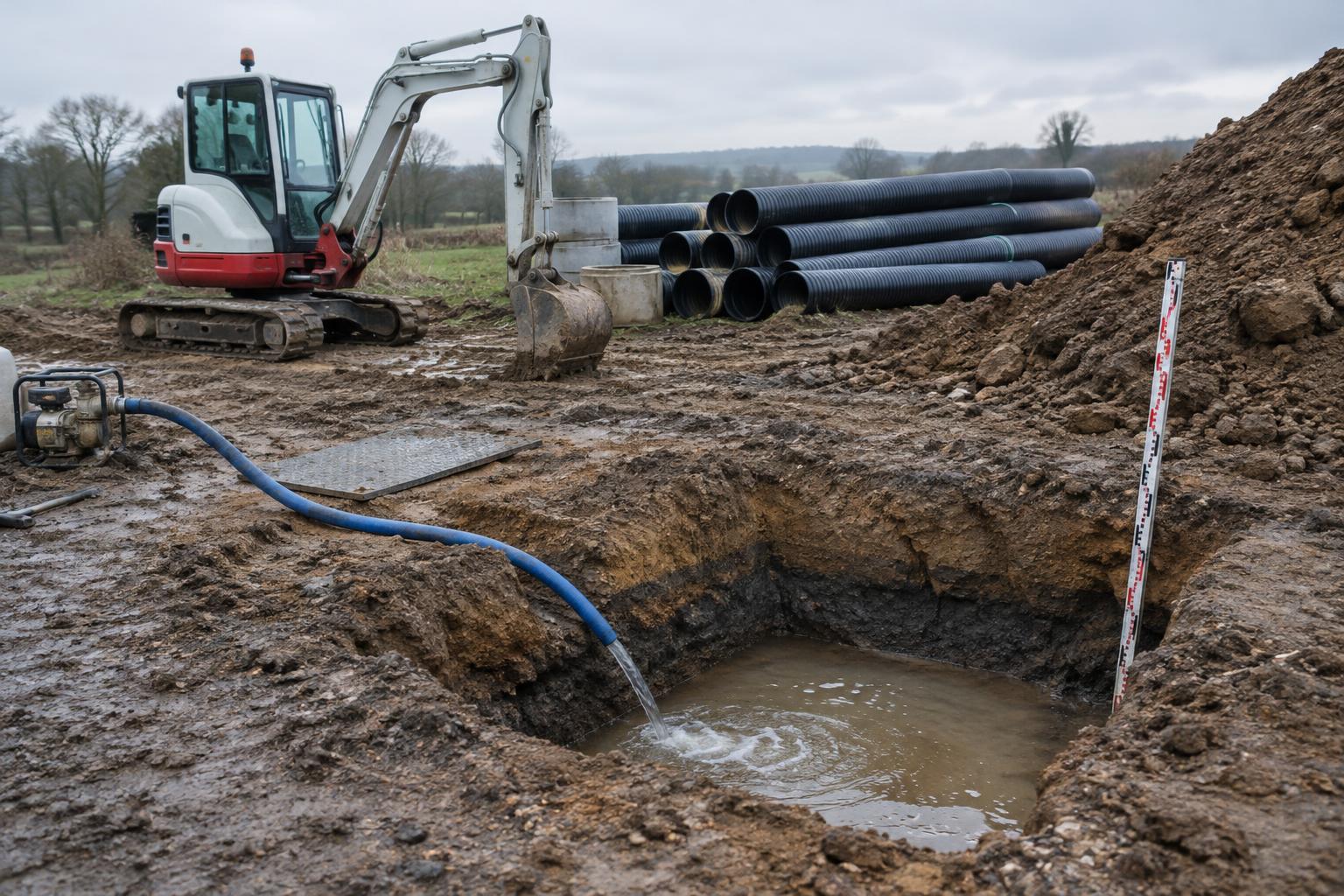
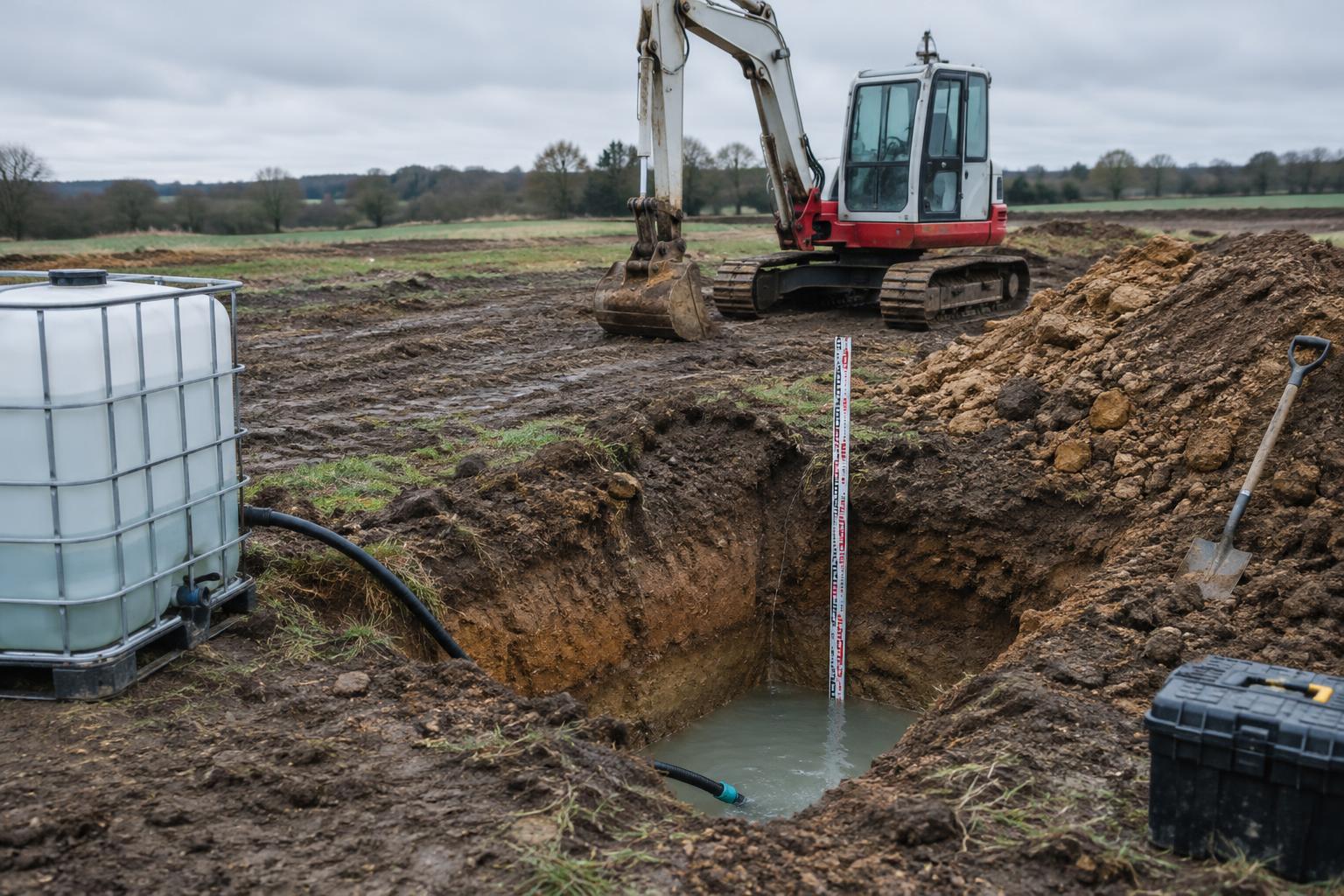
Ground conditions determine whether a soakaway, which allows collected water to drain into the ground, is a viable option. The guide describes infiltration testing as excavating a trial pit and measuring how quickly water drains away, with results expressed in metres per second (m/s). It cautions that infiltration may not be viable at low rates, typically below 1×10^-6 m/s.
Where an objection identifies missing infiltration evidence, the guide recommends results from a UKAS-accredited laboratory or a qualified engineer. A proposed soakaway therefore needs site-specific testing rather than an assumption about ground performance. For other discharge arrangements, the strategy should justify the selected destination; the guide identifies a combined sewer as a last resort and includes outfall or sewer-connection confirmation among potential supporting evidence.
The preparation process starts with topographical information, soil surveys and existing drainage plans, followed by runoff calculations for the site area and percolation testing where soakaways are under consideration. Storage design then needs checking against climate change allowances. The guide also requires drawings covering the drainage layout, construction details and an exceedance plan showing how water is managed when drainage capacity is exceeded.
The accompanying report should explain the design and bring together its calculations and supporting evidence. For an objection that runoff has not been demonstrated, the guide specifies greenfield runoff calculations using approved methods; for incomplete strategy information, it calls for a complete drainage strategy. Where discharge and storage proposals change, the response should provide revised rates and attenuation volumes.
Consultant advises applicants to distinguish evidence gaps from design disputes
The Drainage Designers recommends appointing a qualified drainage engineer or civil engineering consultant who understands the relevant local authority’s requirements to prepare the response. It identifies interpreting technical objections and commissioning outstanding site investigations as part of that role, and suggests early specialist involvement can help avoid a resubmission when time is limited.
Where an applicant believes an objection rests on a misunderstanding, the guide recommends seeking a meeting or telephone discussion with the case officer or LLFA. It says clarification can sometimes settle the issue without a formal resubmission, providing a separate route from preparing replacement documents.
A technically justified objection does not necessarily require the applicant to accept only one design solution, according to the guidance. It suggests negotiating through alternative evidence or a revised design that addresses the concern differently. That approach distinguishes disagreement about the proposed solution from a dispute over whether the authority has identified a valid problem.
For applicants who consider the council or LLFA’s conduct unreasonable, the guide sets out an escalation sequence beginning with a review by the case officer’s manager. A formal complaint through the council’s complaints procedure follows if that review fails to resolve the matter. It also identifies the local government ombudsman as a route for complaints alleging LLFA maladministration.
The guide cautions that escalation rarely settles technical objections. It treats complaints about administrative handling separately from the engineering work needed to secure an acceptable drainage proposal, rather than presenting a complaint as a substitute for resolving the outstanding technical concern.
Applicants face revision, further investigation or refusal
The guidance gives an indicative resolution period of two to four weeks for straightforward objections requiring supplementary infiltration data. Cases involving more extensive drainage revisions or additional site investigation can take several months, it says, with the authority involved and the complexity of the work affecting the programme.
Those periods sit alongside determination targets that the guide gives as 13 weeks for major development and 8 weeks for minor development. It describes these as targets rather than guaranteed decision dates, and says applicants typically have 21 days to provide additional information, although the response period can vary.
Where preparing the response puts an application at risk of refusal, the guide advises applicants to consider agreeing an extension of time with the planning authority. If the site has a fundamental drainage problem that cannot be resolved adequately, it identifies withdrawal and a fresh application with a different strategy as a possible course.
An outstanding objection can lead to refusal if the applicant cannot demonstrate that surface-water management will avoid increasing flood risk elsewhere, according to the guide. It warns that refusal carries financial consequences, including loss of the application fee, which it says can reach several thousand pounds for major development. A recorded refusal may also complicate subsequent applications on the site.
For an application refused solely on drainage grounds, the guide identifies an appeal to the Planning Inspectorate within 6 months of the decision as an option. It characterises appeal as a last resort because of the time and cost involved, rather than the next routine step after an unsuccessful technical exchange.
Why this matters
For drainage and flood risk professionals, the guidance connects the scope of technical work with the applicant’s choice of planning route. Clarification, design negotiation, administrative complaint and appeal serve different purposes; selecting between them affects both the commission and the programme. The practical issue is whether the outstanding concern can be settled within the available determination period or requires a longer investigation, an agreed extension or a fundamentally different proposal.
Frequently asked questions
how do I respond to a drainage objection?
The Drainage Designers’ guide, updated on 8 October 2026, recommends answering each objection separately with supporting evidence. Identify the relevant document and page number, and specify any revised drawings or calculations so the authority can check the response.
why has the council raised a drainage objection?
According to the guide, common causes include missing infiltration tests, absent runoff calculations, an inadequate flood risk assessment or an unclear surface-water discharge route. An objection generally requests further evidence rather than constituting a planning refusal.
who decides planning applications with drainage objections?
The planning authority decides the application. The Lead Local Flood Authority advises on surface water as a statutory consultee. The sewerage undertaker controls public sewer connections, while the Environment Agency handles main rivers and flood zones, according to the guide.
what should a drainage strategy include?
The guide calls for runoff calculations, proposed discharge rates and destinations, infiltration evidence and attenuation volumes: the storage needed to hold water before controlled release. Supporting drawings should show the drainage layout, construction details and routes for water exceeding system capacity.
do I need infiltration testing for a soakaway?
The guide says soakaway suitability must rest on site testing that measures how quickly water drains into the ground. Results establish an infiltration rate in metres per second. Where the ground drains too slowly, infiltration may not provide a viable drainage solution.
what should a flood risk assessment cover?
According to the guide, a flood risk assessment should identify all flood sources, assess risks to the site and demonstrate that development will not increase risk elsewhere. It should address flood zones, surface-water flooding history, local climate change allowances and on-site water management.
how long does it take to resolve a drainage objection?
The guide suggests two to four weeks for straightforward cases requiring supplementary infiltration data. Cases needing a revised drainage strategy or further site investigation can take several months. Applicants may need to agree an extension of time with the planning authority.
can planning permission be refused because of drainage?
Yes. According to the guide, unresolved drainage concerns can lead to planning refusal. Where additional evidence cannot resolve a fundamental drainage problem, the applicant may need to withdraw the application and submit a different strategy.
Related coverage